Continuing our theme of hope in the face of strife from last week with another dose of perspective, today's Artist Spotlight is going to look at the work of a young Assyrian sculptor named Nenous Thabit who has a powerful dose of hope for everyone affected by the destruction wrought by the Islamic State.
Most of the Islamic State's terrorist campaigns are launched at the local people, and one of their most potent weapons is the destruction of local temples and historic sites for being 'un-Islamic'. This breaks the link the local people have with their cultural heritage and, in theory, makes them more likely to embrace the twisted vision of Islam espoused by the terrorists.
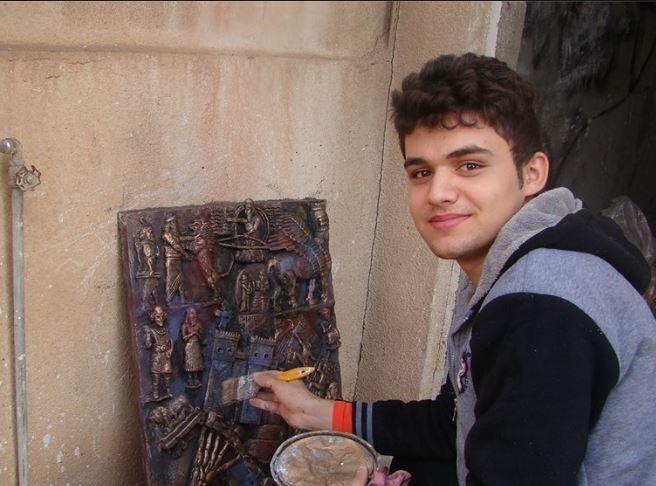
His project will be a long one, but it's truly inspirational - he hopes to recreate many of the most famous works that have been destroyed by the Islamic State. At only 17 years of age, he has been practicing sculpting in his father's workshop, who is a professional sculptor.
Thabit was inspired to action by the destruction of the ancient Assyrian temple of Nimrud, which IS fighters bragged about destroying with sledge hammers and bulldozers for not being Islamic.
“They waged a war on art and culture, so I decided to fight them with art. Lamassu is my favourite statue, it is the strongest creature in the Assyrian heritage.
“In Iraq, there are people who are killed because they are sculptors, because they are artists. Continuing to sculpt is a message that we will not be intimidated by those devils.
“My dream is to become a prominent artist in Iraq to make my country proud and show the world that we in Iraq love life and cherish our heritage.”
So far, he has completed 18 new statues, including one of Lamassu, and is looking forwards to attending art school in the city of Dohuk in the coming year. Hopefully, he'll be able to maintain his optimism in the face of anger, and recreate many more of the lost treasures that so many artists, historians and curators have been racing to preserve.
Posted on November 16th 2016 on 09:04pm
0 Comments
Continuing our theme of New York from the previous week, in this post we're going to take a look at one of the most ambitious and polarizing public art/sculpture/architecture hybrids to be constructed in recent memory. Part of the Hudson Yards redevelopment project taking place on the West Side of Manhattan, the centrepiece will be a massive project by artist Thomas Heatherwick, of Heatherwick Studios.
The CEO of the firm behind the plaza development that will contain the structure, Stephen Ross, was quoted as saying, "It will become to New York what the Eiffel Tower is to Paris, I believe." Bold words, and even more bold for being quoted before the final design for the piece was unveiled - only the price tag. Originally priced at a staggering $75 million USD, the cost has since ballooned to upwards of $200 million USD.
For a sculpture alone, that would be a truly inconceivable amount of money, but the Vessel is going to be far more than a sculpture - it would probably be more accurate to classify it as a very useless building.
The design, which has been described as reminiscent of a hollowed out bedbug exoskeleton (thanks for that imagery, by the way, Gothamist), is actually a scalloped tier of interlocking staircases that scale up over 150 feet. With 154 staircases and at least 80 landings, the piece will no doubt become a hive of activity, which will hopefully draw more appealing and less revolting comparisons to a beehive, once it is filled with the milling masses.
"When I was a student, I fell in love with an old discarded flight of wooden stairs outside a local building site. It caught my imagination and I loved that is was part furniture and part infrastructure. You could climb up stairs, jump on them, dance on them, get tired on them and then plonk yourself down on them."
While that might not be the most eloquent description of the grandiose Vessel project, it certain provides an interesting insight into the nature of the design process of what will no doubt become an iconic New York structure. While it might not attain the cultural heights of the Eiffel Tower, it is sure to become a recognizable part of the West Side skyline.
It's not as terrible as the headline sounds, trust me. Instead, it's something far more hilarious.
Recent visitors to New York and Staten Island have been privy to one of the best-kept nonexistent secret tragedies to befall the United States: The Staten Island Ferry Octopus Attack. No, you didn't miss a news headline - it's all an elaborate stunt by artist Joe Reginella to dupe tourists into searching for a nonexistent museum.
Dubbed "Staten Island Ferry Disaster Memorial Museum", the museum was promoted in some fake brochures passed out around the New York area. Some of the more gullible tourists felt the need to excoriate the United States for concealing such a tragic accident, although it's likely that they'll simply pretend they were in on the joke.
A beautiful statue was erected on the Staten Island Ferry Docks for a brief time, commemorating the "disaster", and we can only hope that it will be retained somewhere as an ongoing exhibit, even if it's necessary to inform visitors that it never really happened.
Reginella describes the entire project as "part practical joke, part multimedia art project, part social experiment."
Here's the elaborate description of the event from the website:
"It was close to 4am on the quiet morning of November 22, 1963 when the Steam Ferry Cornelius G. Kolff vanished without a trace. On its way with nearly 400 hundred people, mostly on their way to work, the disappearance of the Cornelius G. Kolff remains both one of New York’s most horrific maritime tragedies and perhaps its most intriguing mystery. Eye witness accounts describe “large tentacles” which “pulled” the ferry beneath the surface only a short distance from its destination at Whitehall Terminal in Lower Manhattan. Nobody on board survived and only small pieces of wreckage have been found…strangely with large “suction cup-shaped” marks on them. The only logical conclusion scientists and officials could point to was that the boat had been attacked by a massive octopus, roughly half the size of the ship. Adding to the tragedy, is that this disaster went almost completely unnoticed by the public as later that day another, more “newsworthy” tragedy would befall the nation when beloved President John Fitzgerald Kennedy was assassinated. The Staten Island Ferry Disaster Museum hopes to correct this oversight by preserving the memory of those lost in this tragedy and educating the public about the truth behind the only known giant octopus-ferry attack in the tri-state area."
Posted on September 23rd 2016 on 07:27pm
0 Comments
In today's edition of Artist Spotlight, we're going to take a look at an artist whose work could also be featured in a version of our Public Art series, but unlike most public works of art, they don't exist in a fixed place. Dutch-born artist Theo Jansen has been active in the artist community almost since birth in 1948, but it wasn't until 1990 that he first began work on the pieces that he is now best known for. (So for all of you still waiting for your big artistic break, don't lose heart!)
Enter the Animari. These works are massive kinetic sculptures that move entirely thanks to their unique construction and powered by the wind alone. We've included a video here because they need to be seen to be believed, and a picture really doesn't do them justice.
Jansen explains how the sculptures move in a detail on his website: "Self-propelling beach animals like Animaris Percipiere have a stomach. This consists of recycled plastic bottles containing air that can be pumped up to a high pressure by the wind. This is done using a variety of bicycle pump, needless to say of plastic tubing. Several of these little pumps are driven by wings up at the front of the animal that flap in the breeze. It takes a few hours, but then the bottles are full. They contain a supply of potential wind. Take off the cap and the wind will emerge from the bottle at high speed. The trick is to get that untamed wind under control and use it to move the animal. For this, muscles are required. Beach animals have pushing muscles which get longer when told to do so. These consist of a tube containing another that is able to move in and out. There is a rubber ring on the end of the inner tube so that this acts as a piston. When the air runs from the bottles through a small pipe in the tube it pushes the piston outwards and the muscle lengthens. The beach animal's muscle can best be likened to a bone that gets longer. Muscles can open taps to activate other muscles that open other taps, and so on. This creates control centres that can be compared to brains."
Eerie, beautiful and undeniably fascinating, these sculptures beg us questions about the nature of artificial life, and by extension, of our own supposedly "natural" life.
"I make skeletons that are able to walk on the wind, so they don't have to eat. Over time, these skeletons have become increasingly better at surviving the elements such as storm and water and eventually I want to put these animals out in herds on the beaches, so they will live their own lives."
Posted on February 05th 2016 on 04:33am
0 Comments
Ukraine has been in the news a lot lately, thanks to the much publicized struggle going on between nationalists and pro-Russian separatists, but that's not all it's been making headlines for. Back in April of this year, the Ukrainian parliament passed a law that has become commonly known as the 'de-Communisation Law', an attempt to retrofit the public culture of modern Ukraine to more accurately match the views of its citizens. A large part of this effort revolves around the removal of Communist-themed public artworks and art installations, from sculptures to plaques to murals to statues.
Enter Ukrainian-based artist Alex Milov, who was actually born in the Soviet Union and has watch the rise and fall of Communist power in the region. He provided a truly unique twist on a sculpture of Soviet-era dictator Vladimir Lenin by transforming the statue into that of Darth Vader, the equally iconic fictional character from the Star Wars film franchise. Located in Odesa, the newly improved statue received a number of upgrades in addition to its cosmetic enhancements, which include the classic cape and helmet combination that helped make Vader so iconic in the first place.
In addition to this new attire, however, the statue was also reinforced with new construction materials to ensure that it withstands the tests of time, a helmet constructed of a titanium alloy and the whole lot painted black with a fresh coat of paint to complete the outfit. As if that wasn't excellent enough, there is also a Wi-Fi internet router located in Vader's helmet which provides free connectivity for anyone in the area. It still gets better, though. Like Han Solo trapped in carbonite, the original bronze Lenin statue is still there, inside Vader's outer trappings. "The bronze Lenin was left inside, so that the grateful or not-so-grateful descendants could exhume him if needed," Milov explained to the Ukraine Today newspaper.
"I wanted to make a symbol of American pop culture which appears to be more durable than the Soviet ideal," Milov said, speaking to the BBC. Ukraine, it seems, has managed to maintain its sense of cultural irony throughout the trying times it has seen recently, something hopefully all of us will be able to do through the power of our artwork.
It's no secret that 3D printing has been taking the world by storm over the past couple of years. From 3D printing custom mobile phone cases to 3D printing entire houses, it's an entirely new paradigm when it comes to the construction of objects large and small. It's probably no surprise, therefore, that there is a lively and developing community of artists who are taking advantage of the new technology to explore sculpture and modeling in entirely new ways.
Probably the most appealing element of the ongoing 3D printing revolution is the development of different materials that can be printed. Original 3D printers were slow, clunky, and extremely limited in terms of the kind of materials they could construct with. Often, users were limited to one type of plastic, but as the technology has evolved, so too have the materials available to both makers and artists.
The piece shown to the right is actually a 3D printed sculpture executed entirely in sandstone by Swiss architects Michael Hansmeyer and Benjamin Dillenburger, entitled Arabesque Wall. It's currently on display in a gallery in Toronto, Canada, as part of an exhibit on 3D printing by the Design Exchange entitled 3DXL: A Large-Scale 3D Printing Exhibition. Not exactly the catchiest title, but the exhibit is part technical showcase and part art exhibit, so perhaps they can be forgiven.
As Design Exchange president Shauna Levy explained to the CBC, “Up until now, 3D printing has been almost behind a veil and has been a mystery to many people.” The exhibit features the work of 3D designers and artists from around the world, and will be on display until August 16 in downtown Toronto.
Visitors can also see 3D printing in action thanks to a working 3D printer that is creating life-sized chairs for an installation that is part of the exhibit. Each chair takes 11 hours to make, so you probably won't have the patience to see one spring to life from nothing while you watch unless you're extremely lazy, but it's still fascinating to watch for a minute or two. When you then compare the relative simplicity of the chair construction to the wildly intricate complexities of Arabesque Wall, you finally begin to truly appreciate the wide range of possibilities that 3D printing provides artists, designers, and makers of all tastes and talents.
Remember our recent post on the uncommissioned sculpture of NSA whistleblower Edward Snowden that was erected in a Brooklyn, NY park one night at the beginning of April, and taken down the very next day? (In case you didn't here's a link to the original post discussing the sculpture itself). Well, not to be outdone by perceived censorship, a completely different group of artists banded together to create a hologram of the original Snowden bust in the very same park.
The artist group, apparently known as 'The Illuminator Art Collective' (doubtless a reference to the holographic nature of their work), had this to say:
"Inspired by the actions of these anonymous artists, The Illuminator Art Collective recreated the intervention ephemerally by projecting an image of the sculpture into a cloud of smoke. Our feeling is that while the State may remove any material artifacts that speak in defiance against incumbent authoritarianism, the acts of resistance remain in the public consciousness. And it is in sharing that act of defiance that hope resides."
The original trio of artists who created the initial sculpture seemed a bit surprised but pleased when they learned of the holographic tribute, although they probably wished they'd taken the time to come up with a snazzy name for their collaboration. Their response, press-release style, states:
"We were surprised to see the way the statue was covered up before its removal, as though it were a profane statement. We were equally heartened to see the outpouring of support New York, and people online, have shared. Seeing flowers on the now empty monument was incredibly inspiring, but when another group of artists "reinstalled" the bust and nameplate in light, we were truly touched. It proves the meaning of the piece, and the tough questions it forces us to answer, will endure even though it's no longer physically present. We're thrilled this has inspired others to take creative action towards raising awareness about what it means to be an American, and a hero."
Apparently, the Illuminator Art Collective regularly works with activist groups in the attempt to bring public awareness to their particular campaigns, although it must be said that this writer has never run across their work before. There is a certain beauty to the idea of replacing supposedly censored artworks with holographic memories of the originals, but the inherently fragile nature of a hologram almost seems more of a funereal dirge than a celebration.
In this edition of the Artist Spotlight, we're going to take a look at Myeongbeom Kim, a sculptor trained on both sides of the Pacific Ocean. Originally studying in Seoul, South Korea, and earning a Bachelor of Fine Art in Environmental Sculpture, he began to study and sculpt for his Master's Degree at the famous Art Institute of Chicago. Since then, he has been dividing his living and working time between Seoul and Chicago, and it seems like this duality may have created an interest in intersections of culture, as the theme of unexpected intersection seems to run throughout the majority of his work. The results are nothing short of zen surrealism, if such a thing can be said to exist at all (although this question itself might be said to be zen surrealism). .
Each piece has a stunning simplicity, but captures a haunting, surreal beauty and makes you do a double take. The intersection of man-made objects and the natural world is a frequent source of subject matter, but one of this writer's personal favourites is the one-legged chair being held up by a giant cluster of helium balloons.
Speaking to mymodernmet.com, Kim had this to say about his work: "I try to examine how my surroundings are perceived and remembered. To do this, I listen to a whisper from the objects within my surroundings. I attempt to have an intimate, private dialogue with the world, trying to concretely present the way things approach me, by using other mediums.
"To ask what an objects means to me is like asking what being I am. I have consistently experienced my surrounding objects from the perspective of life, growth, and decline, which lends vitality to my work."
Considering the importance of life, growth, and decline, it will be interesting to see how the young tree to which a wooden chair was affixed will grow around the sculpture. While I have a few reservations about using actual living plants in artistic works, I'm still curious to see how it will turn out both visually and conceptually. It's no wonder that Kim has been featured in galleries around the world, as well as received numerous awards and plaudits for his work.
To see his portfolio of work, visit his website here (although it appears to be a bit buggy, which is disappointing - guess he should have used Gallereo!)
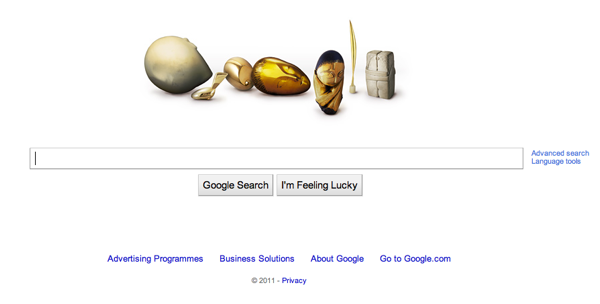
Google continues it's great run of themed 'Google Doodles', each celebrating a specific date or occassion. Today's graphic sees the Google logo transfored into a series of sculptures by Romanian-born artist Constantin Brâncuşi.
Today marks Brâncuşi's 135th birthday and so it seems a fitting day to take a sneak peak at the sculptors life, and why he has successfully made it into the records of art history.
Born in Romania in 1876, Brâncuşi proved to have a talent for sculpting from an early age where he would competently carve wooden farm tools. As he got older, he took those skills forward formally, first in Bucharest and Munich, before reaching the pinnacle of artistic schooling at the École des Beaux-Arts in Paris.
In Paris, Brâncuşi honed his skills, and perfected a clean, geometric style with an astounding sense of balance and abstract symbolism. His brave style and creative artistic output in the early 20th-century has earned him the accolade of being considered one of the foremost pioneers of modernism.
Interestingly, in his early days in Paris, Brâncuşi was invited to study at the studio of Auguste Rodin, a titan in the world of sculpture. After two months at the studio, Brâncuşi left, saying that "nothing can grow under big trees". Brâncuşi felt that, due to Rodin's position and stature as a sculptor, he would be less able to develop a style true to himself if he continued to work there. Brâncuşi showed a strength of character that undoubtedly allowed him to really work to define himself as an artist, instead of remaining in the shadows of his teachers.
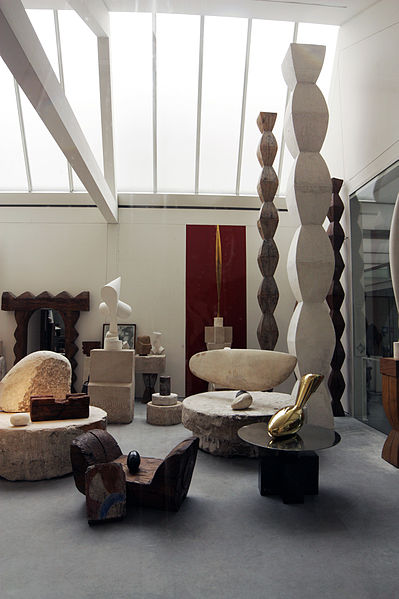
Works in Atelier Brâncuşi, Paris.
Photograph by Edal Anton Leftrov, 2010
Along with Rodin, Brâncuşi also spent time with Pablo Picasso, Man Ray and Henri Rousseau; a vibrant selection of artists, who no doubt helped Brâncuşi to reach his full potential and revolutionise sculpture for future generations.
Brâncuşi worked with a range of materials including marble, bronze, limestone and wood, and by the time of his death in 1957 he had created more than 215 sculptures. Amongst his most famous works are Sleeping Muse (1908), The Kiss (1908), Mademoiselle Pogany (1913), Bird in Space (1919) and The Column of the Infinite (1938).
At the time of his death, a large body of his work was bequeathed to the Romanian Government, however they turned it down, and it was given, instead, to the French Government. A great many of Brâncuşi's works can be seen today in museums around the world, where we can celebrate his contribution to art and art history.
Posted on February 19th 2011 on 12:26pm
0 Comments
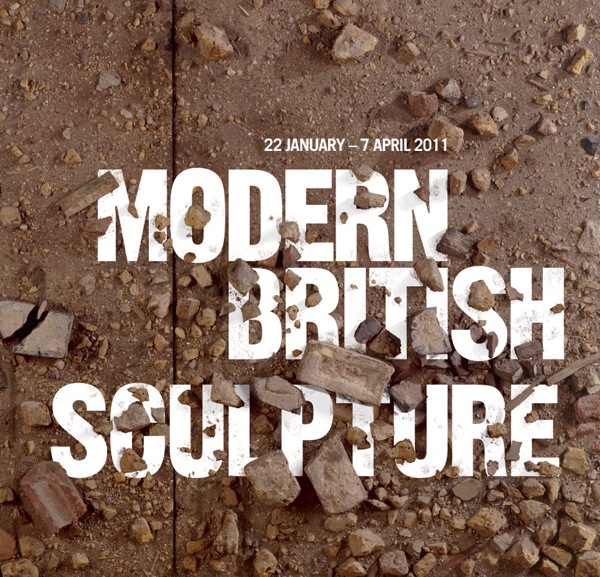
The Royal Academy of Arts in London is to present the first major exhibition, in 30 years, to take a good look at the state of British sculpture in the twentieth century. The show is to be an exploration of what it means for something to be a British sculpture, and how such creations sit within the broader context of British links with its Empire, continental Europe and the United States.
Ordered chronologically, but presented as an array of unconventional juxtapositions, the exhibition looks set to challenge established thought on the matter of British sculpture and to form new discussion and concepts.
Amongst the sculptors to go on show will be Jacob Epstein, Barbara Hepworth, Henry Moore, Richard Long, Damien Hirst and Leon Underwood, ensuring that there will be a little bit of something for anyone with a taste for the 3-dimensional art form.
With significant loans from both the British Museum and the V&A, visitors can also expect to be taken beyond the traditions of the British Isles, in terms of sculptural subject matter. Native American, Indian and African traditions will be highlighted amongst the material, as the exhibition looks at the way in which curious British artists took to drawing on influences from around the world.
As well as looking at the traditions and influences within the range of sculpture on show, the exhibition will also tackle the choices that artists faced between figurative and abstract creation. In the early part of the twentieth century, sculpture still held both commemorative and political duties, forcing sculptors to either comply with tradition, or to look to break the mould.
The exhibition opened today and will run until the 7th April 2011. Make sure you check out the Royal Academy website for more information!




 Continuing our theme of hope in the face of strife from last week with another dose of perspective, today's Artist Spotlight is going to look at the work of a young Assyrian sculptor named Nenous Thabit who has a powerful dose of hope for everyone affected by the destruction wrought by the Islamic State.
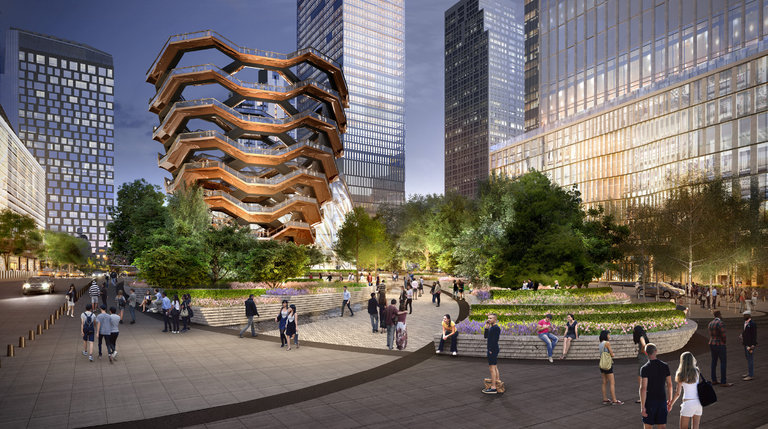 Continuing our theme of New York from the previous week, in this post we're going to take a look at one of the most ambitious and polarizing public art/sculpture/architecture hybrids to be constructed in recent memory. Part of the Hudson Yards redevelopment project taking place on the West Side of Manhattan, the centrepiece will be a massive project by artist Thomas Heatherwick, of Heatherwick Studios.
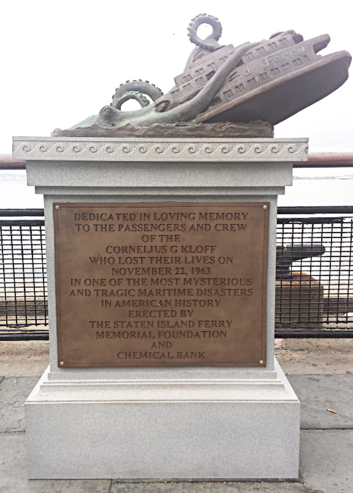 It's not as terrible as the headline sounds, trust me. Instead, it's something far more hilarious.
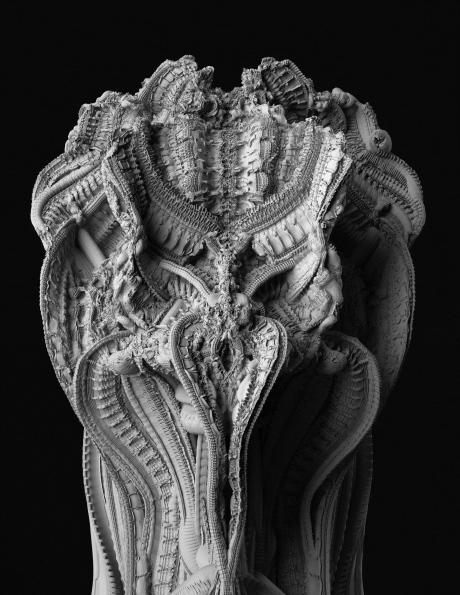 It's no secret that 3D printing has been taking the world by storm over the past couple of years. From 3D printing custom mobile phone cases to 3D printing entire houses, it's an entirely new paradigm when it comes to the construction of objects large and small. It's probably no surprise, therefore, that there is a lively and developing community of artists who are taking advantage of the new technology to explore sculpture and modeling in entirely new ways.
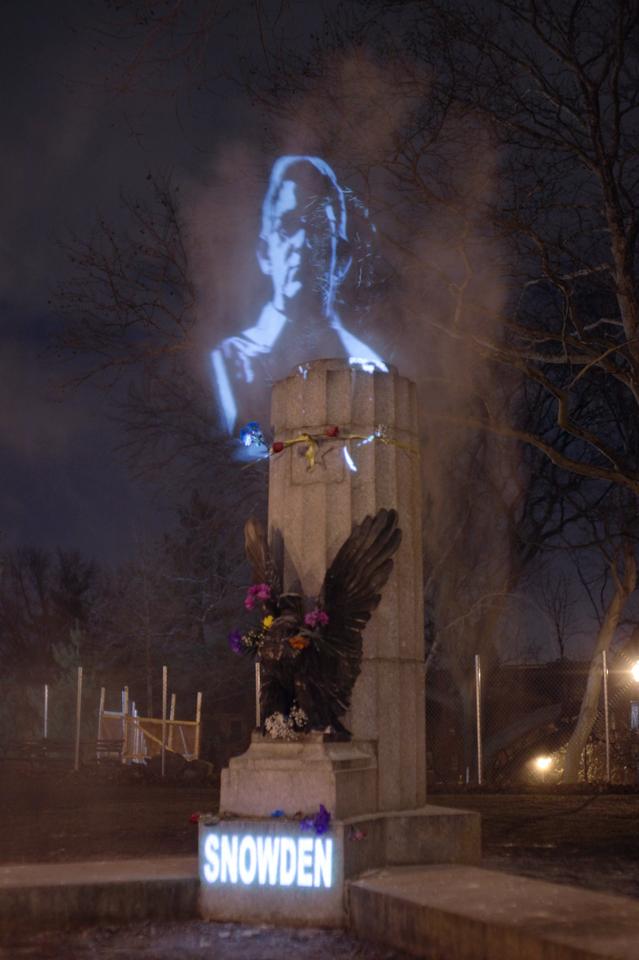 Remember our recent post on the uncommissioned sculpture of NSA whistleblower Edward Snowden that was erected in a Brooklyn, NY park one night at the beginning of April, and taken down the very next day? (In case you didn't here's a link to the original post discussing the sculpture itself). Well, not to be outdone by perceived censorship, a completely different group of artists banded together to create a hologram of the original Snowden bust in the very same park.
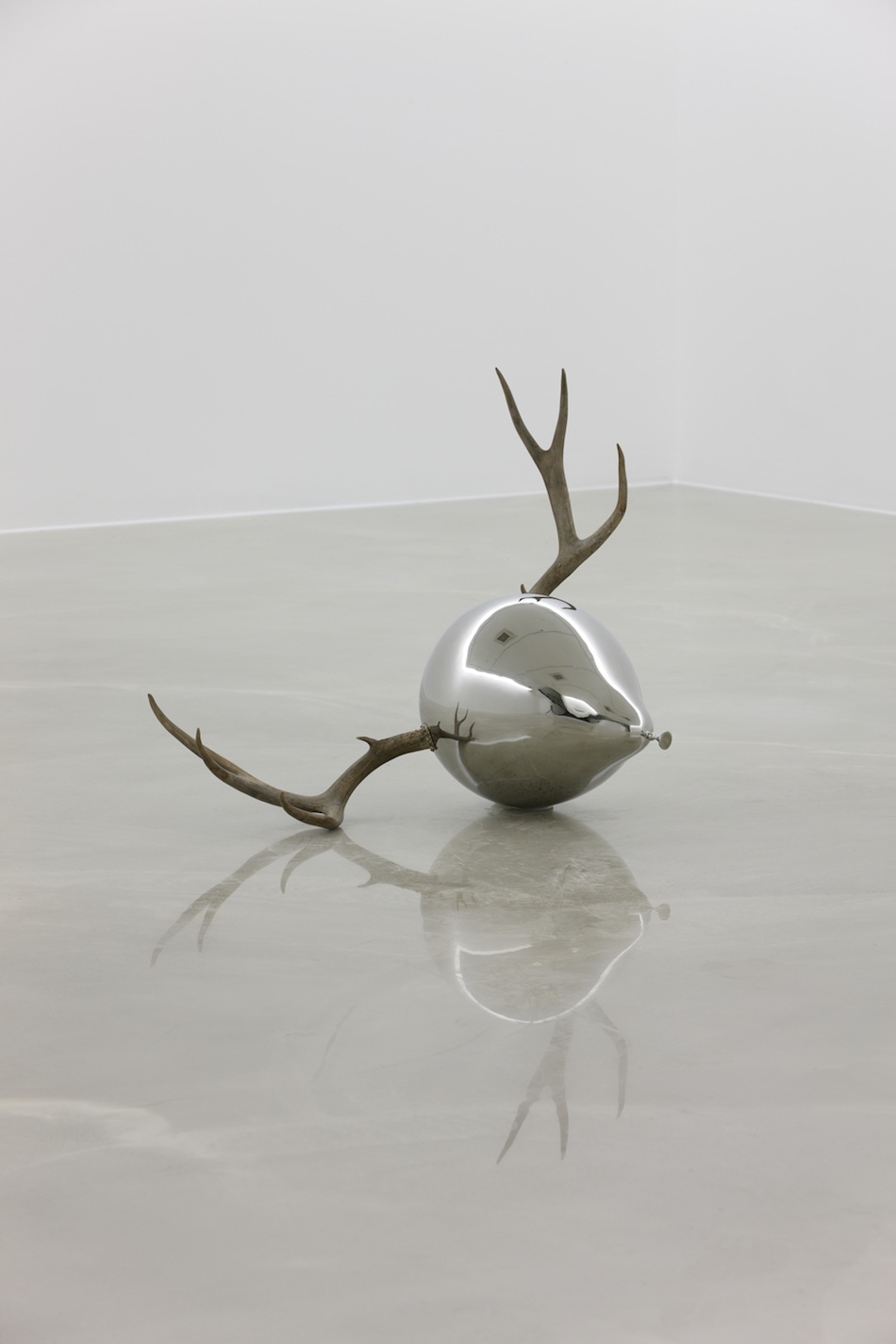 In this edition of the Artist Spotlight, we're going to take a look at Myeongbeom Kim, a sculptor trained on both sides of the Pacific Ocean. Originally studying in Seoul, South Korea, and earning a Bachelor of Fine Art in Environmental Sculpture, he began to study and sculpt for his Master's Degree at the famous Art Institute of Chicago. Since then, he has been dividing his living and working time between Seoul and Chicago, and it seems like this duality may have created an interest in intersections of culture, as the theme of unexpected intersection seems to run throughout the majority of his work. The results are nothing short of zen surrealism, if such a thing can be said to exist at all (although this question itself might be said to be zen surrealism). .